Isabelle Bullock (MRes Archaeology, University of Birmingham) shares her experience working on ARTEMIS
It feels fitting that a project named ARTEMIS would involve a hunt. Luckily for the wildlife surrounding the Sanctuary of Artemis at Brauron, our hunt involves uncovering traces of past human activity within the landscape. The project began with orientation, including the basic principles of survey. Having only excavated in the past, I came into the project questioning how much information could be ascertained from out of context surface material. It quickly became clear, however, that survey is invaluable for a project like this one. By documenting artefact distributions across an extensive area, we can begin to understand how people engaged with and used the landscape over time. I have also found survey to be a particularly rewarding method of investigation. Being able to pick up pottery and lithic fragments that are thousands of years old directly from the surface is an experience I never thought I would have. My favourite find so far has been a lithic blade that I discovered during a coastal hiking survey day. The only evidence of human activity that we discovered that day dated to between the Neolithic and Bronze Age, with the lack of other Greek settlement evidence making sense given the rather inhospitable terrain.
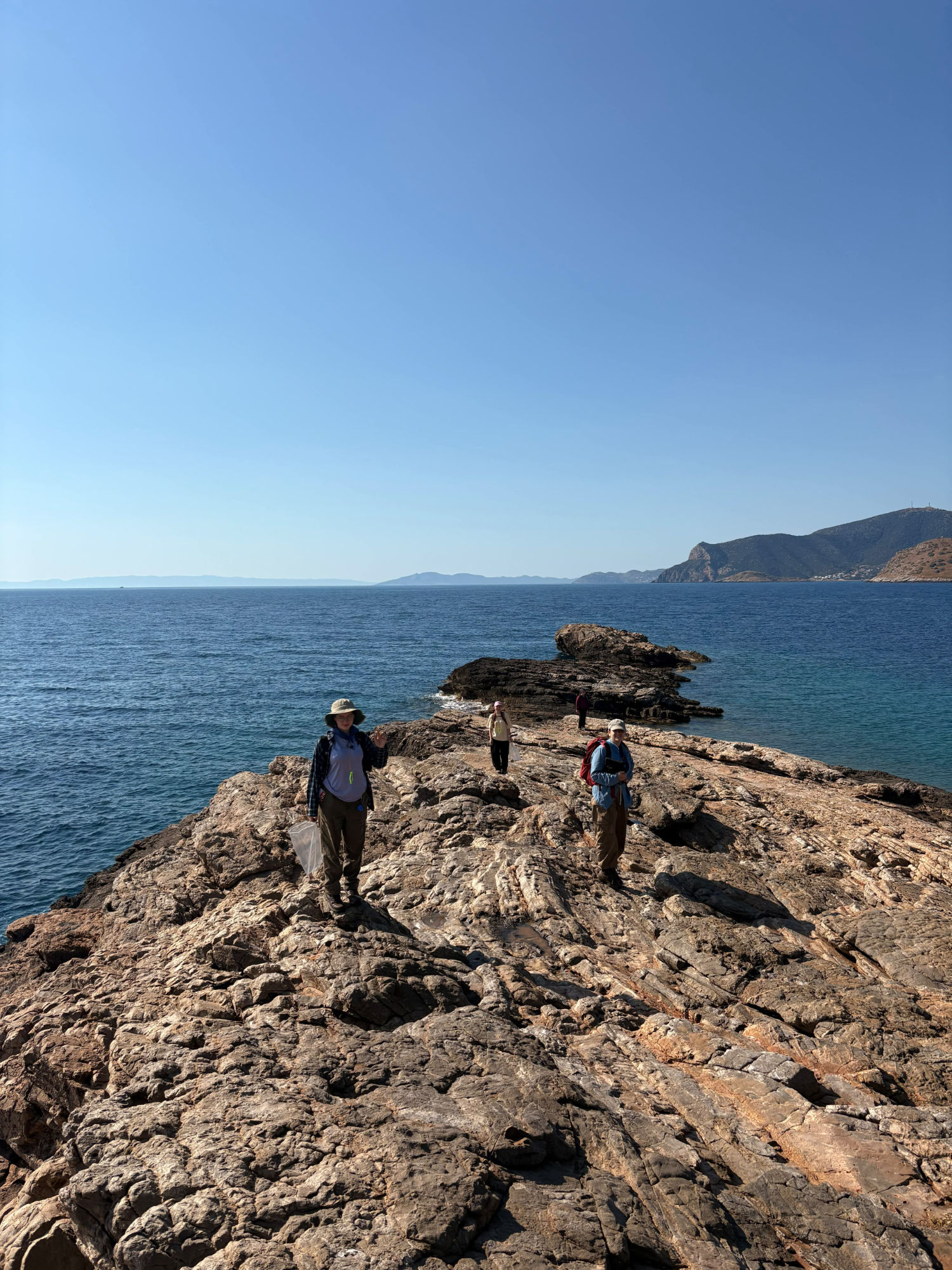 Surveying Chamolia. Photo: Anika Sosa.
After a week of surveying, I rotated into the museum team, which gave me the opportunity to gain experience handling and cataloguing our finds. Days in the museum start an hour later! (And with a coffee stop!!). After washing the finds from the previous day and laying them out to dry in the Greek sun, previously cleaned finds need cataloguing. Fuelled by donuts and biscuits given to us by Greek colleagues at the museum, cataloguing involves describing different attributes of pottery sherds, with the select number of diagnostic finds from a survey unit then providing information about the unit area as a whole. Having never handled pottery to this extent before, let alone cataloguing it, it was exciting to learn about the documentation process and the way in which our finds are interpreted to provide a bigger picture of object distribution and consequently landscape use.
And the learning doesn’t stop out in the field or in the museum! We were taken on a road trip to Euboea, the second largest Greek island, to explore its archaeology. One focus of the day were the Lefkandi burials. Described as ‘the light in a dark age’, the Lefkandi toumba and surrounding cemeteries are one of the pieces of settlement evidence that survive in tenth century BCE Greece. The lavish burial of a cremated male (? identified by his burial with a sword) and an interred woman within a large, sophisticated building that was buried beneath a mound was surrounded by cemeteries, suggesting the existence of a settled community despite the Bronze Age collapse which is supposed to have led to a dark age with no extensive settlement. The Lefkandi burials force us to think about the complexities of history that broad grand narratives – like that of a complete ‘dark age’ – often overlook. Similarly, the evidence of girlhood ritual at the Sanctuary of Artemis at Brauron challenges the mainstream perspective regarding a completely male dominated ancient Greece in which girls were not able to display any autonomy.
On our visit to Evia, we also visited museums, allowing us to look at examples of pottery similar to those which we were finding on ARTEMIS. The new archaeological museum at Chalcis displayed examples of pottery chronologically and typologically simultaneously – two of our cataloguing attributes. It was engaging to see the material culture arranged in this way as it helped visualise some of the cataloguing we had been doing. Seeing diagnostic pottery within the museums also helped with our identification.
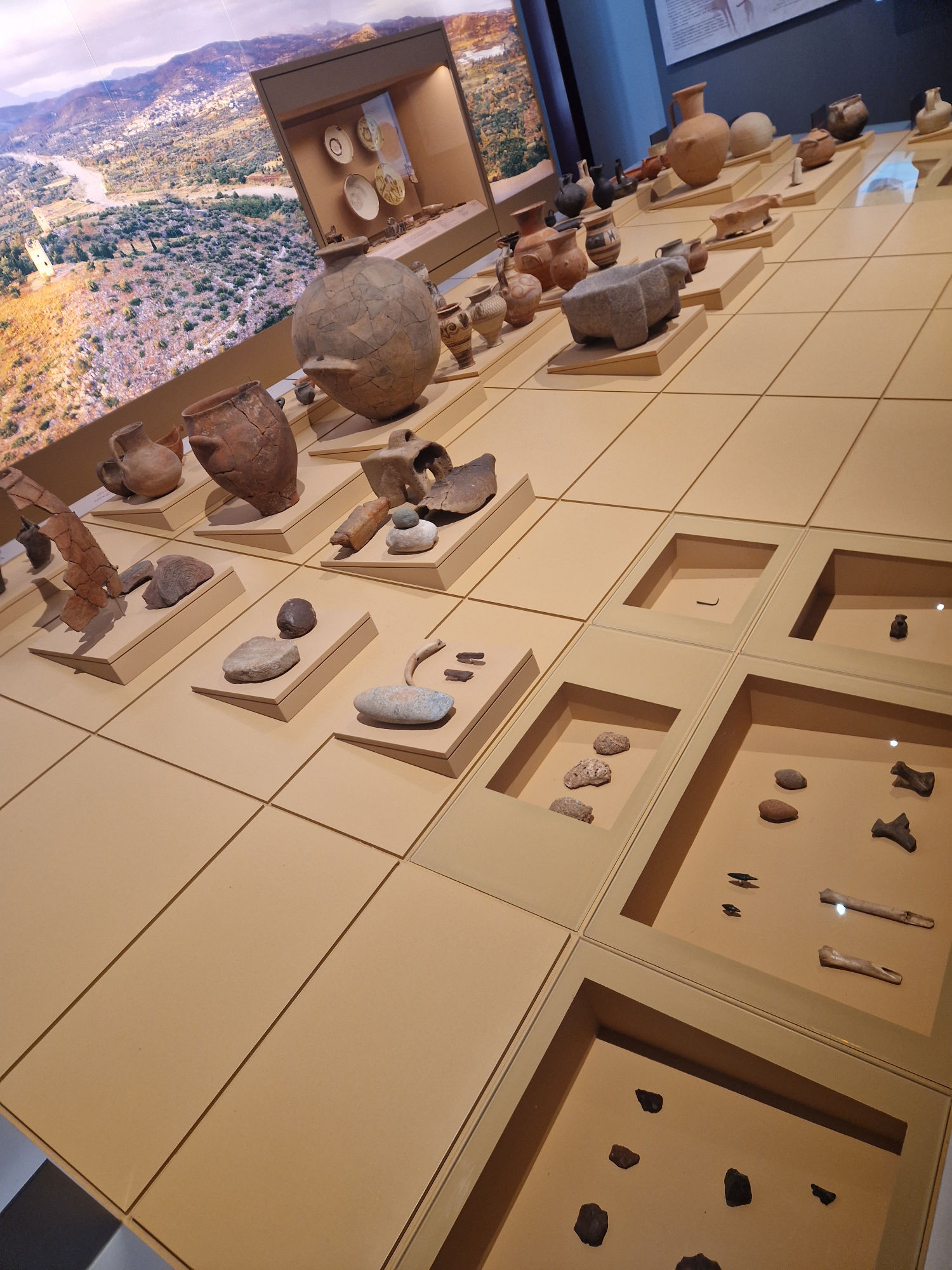 Objects from the Chalcis Museum. Photo: Isabelle Bullock.
For example, River Ramirez (museum supervisor) explained the difference between Mycenaean and Geometric concentric banding. Whilst such Mycenaean decoration appears inconsistent, during the Geometric period a banding wheel was invented which ensured that the paint brushes adding the rings remain a consistent distance apart, creating a more uniform design. So, even the weekends are for learning!
Looking ahead, I feel fortunate to have spent a week in the museum before returning to my final two weeks of fieldwalking. The experience has given me a much better understanding of diagnostic pottery, and I now feel far more confident about recognising it during survey.